
Sodas Not Included
What a Hardware Store Ad Taught Me About Creating a Book Title That Keeps Its Promise

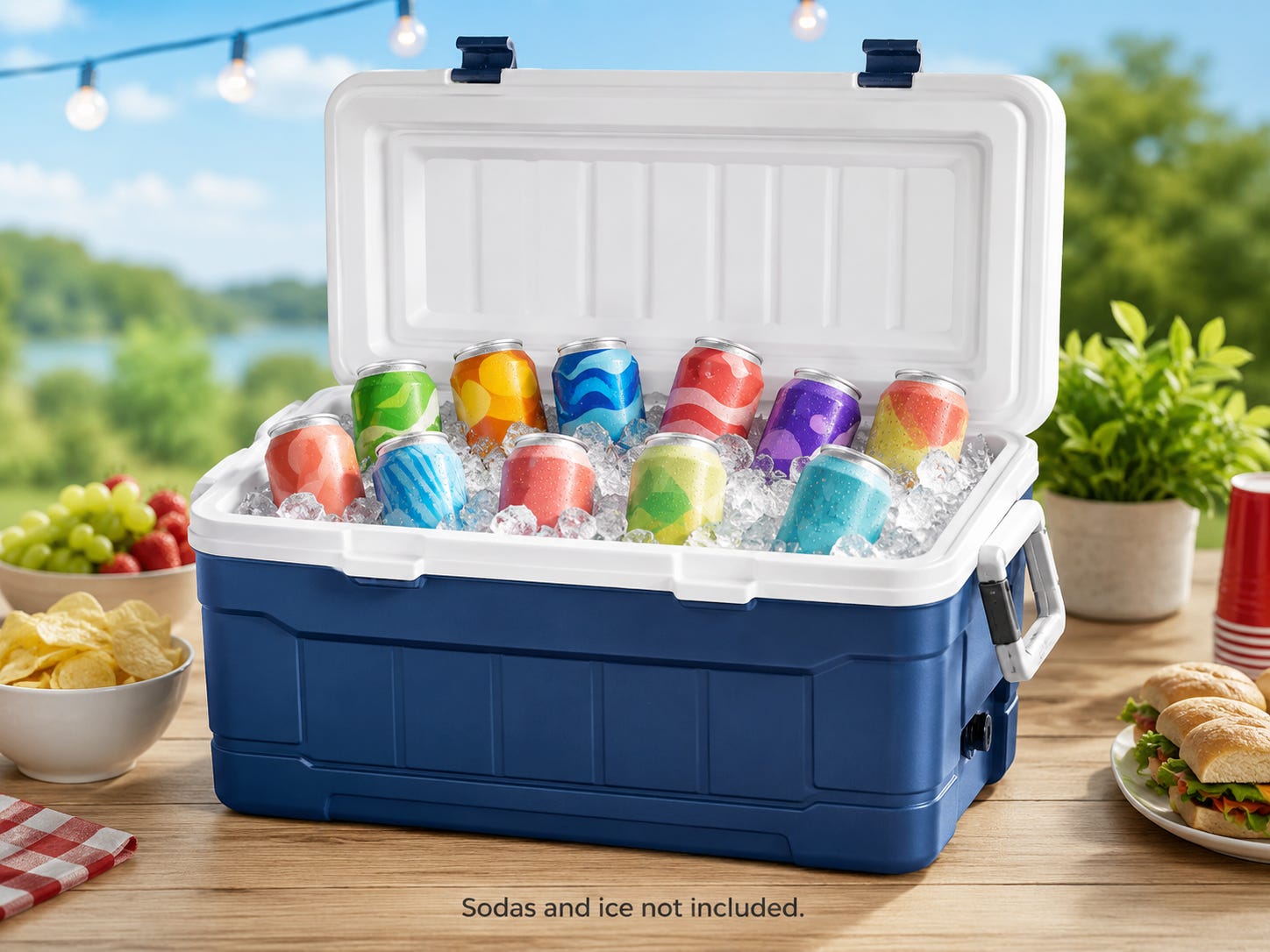
An ad for a party cooler at my local hardware store caught my eye—the cooler was pictured packed with ice and canned soda, and in small print underneath: “Sodas and ice not included.”
Most of us understand a styled product photo when we see one. The disclaimer wasn’t really there to inform anyone—it was the store’s insurance against the rare customer who’d demand a refund or threaten legal action by claiming they were misled.
That’s the exact problem a bad book title creates.
Your title is the picture on the box. It tells readers what’s inside before they ever crack the cover—and when what’s inside doesn’t match what the title promised, you get the equivalent of an angry customer staring into an empty cooler.
A good cover gets attention. A good title makes a promise. Every tip below is really about the same thing: keeping that promise so the words on the spine deliver exactly what’s between the covers—whether you’re writing a novel, a memoir, or a practical how-to guide.
1. Boil your book down to one sentence—then mine it for your title.
Within that sentence are usually the exact words your title needs. When Robert Kiyosaki was finishing his book, a publisher pushed him toward the safe, forgettable title The Economics of Education. He kept his own line instead: If You Want to Be Rich and Happy, Don’t Go to School. That sentence was the actual promise of the book — the safer title would have buried it.
2. Don’t let your title get mistaken for someone else’s.
Titles can’t be copyrighted, but borrowing too close to an existing one can still cost you. Author Randall Hansen watched sales of his 2009 book Fire and Fury spike overnight, only to realize buyers were confusing it with Michael Wolff’s 2018 bestseller of the same name, about the Trump White House. Hansen’s book is about Allied bombing campaigns in WWII Germany — a very different read. Mismatched expectations like that don’t just disappoint readers; they generate refund requests and one-star reviews.
3. Let the title surface while you write—don’t force it on day one.
A working title is fine for early drafts. By the time the manuscript is done, it usually tells you what it’s actually promising, and the real title becomes obvious.
4. Match your title’s tone to your book’s tone.
A how-to book with a title that sounds like a steamy romance might earn some curious clicks, but it sets up a promise the content can’t pay off—and readers who feel tricked say so, loudly, in reviews.
5. Notice how people naturally describe your book once it exists. The producers of That ’70s Show cycled through several working titles — Teenage Wasteland, The Kids Are Alright, Feelin’ All Right — most of them blocked by song-rights issues. The one that finally stuck came when co-creator Bonnie Turner heard an audience member call it “that show about the ’70s.” It was the description people were already reaching for, not a clever invention.
6. Listen to how you describe your book out loud.
John Gray was explaining the differences between men and women during a talk when he said, “Men are from Mars; women are from Venus.” That offhand line became his book’s title—because it was the most honest, compressed version of the promise he was already making to his audience.
7. Choose clear over clever.
“How-to” titles remain reliable sellers because they tell readers exactly what they’re getting. “Murder at the [location]” still works for mystery readers. “[Number] Ways to [outcome]” still works because the promise is stated plainly instead of hidden behind wordplay.
8. Add a subtitle if your main title can’t keep its promise alone.
Captain John W. Trimmer’s How to Avoid Huge Ships is a serious manual for small-boat operators navigating shipping lanes. Without a subtitle to ground it, the title read as comedy bait—and readers obliged, leaving over a thousand reviews joking about the title instead of discussing the content. Funny for onlookers, but it’s currently a $189.99 book that became famous for the wrong reason. A subtitle could have done the work the title alone couldn’t.
9. Sometimes the boldest promise is the riskiest one—and that’s fine.
A modest, careful title isn’t always the safer bet. Shit My Dad Says by Justin Halpern, Another Bullshit Night in Suck City by Nick Flynn, and The Subtle Art of Not Giving a F*** by Mark Manson are all blunt, even crude—but each one tells readers precisely what tone to expect before they read a single page. None of them tried to be tasteful. They told the truth about what was inside, loudly.
Which of these nine ideas points you toward your own title? I’d love to hear—hit reply or drop it in the comments below.
If this helped you settle on your title—or rethink one you’d already settled on—pass it along to another writer working on theirs.
I compiled a book of my mother's memory essays. The title, I think, was a good fit for it. It is "My Flint Hills Childhood: Growing up in 1930s Kansas." Her stories won the Kansas History Book Award the year it came out. She was thrilled with her book.
This is exactly what I needed today. I’m solid on one of my non-fiction books and the second isn’t where it needs to be and your examples and experience has been what I needed to hear. Ahhh so good. Thank you 😊